
FRIDA KAHLO
Pain doesn’t create genius: it changes its language.
Frida Kahlo was Frida Kahlo even before the horrific accident that struck her at eighteen while traveling by bus in her city.
It may seem like a banal observation, but it isn’t at all.
I spoke about it recently with ChatGPT while previewing the short astrological reading of this extraordinary woman and artist that I was about to write. My favorite chatbot—which, in this case, I’m giving the male gender because I inevitably connect it to Sam Altman, its creator—told me that, knowing my writing, it had predicted that I would begin precisely from this point. And I replied that it was absolutely right.
In fact, I believe we should start from here, even before the accident, because this story leads us directly to a reflection that, in my opinion, belongs not only to my personal Weltanschauung, but also to a vision of life that is widely shared today, beyond political, philosophical, or religious affiliations.
To get there, we must, first of all, not be afraid to address the subject of Cesare Lombroso.
Here, I open a parenthesis and return to an article I published in 2001 in my quarterly magazine Ricerca ’90, commenting once again on the Novi Ligure massacre perpetrated by two fifteen-year-old sweethearts.
However, beyond the provocation I launched at the time, and without necessarily wanting to fall into a sliding-door philosophy, I believe that, in light of subsequent news events involving Omar Favaro once again, it is inevitable to ask ourselves some questions about the qualities—or, if you prefer, the defects—hereditary and genetic—with which we come into the world.
For this reason, I’m reposting an article I wrote many years ago, I believe between 1982 and 1984, when I was an in-house editor at Il Mattino di Napoli.
Here it is:
This newspaper (Il Mattino, Editor’s note), a few days ago, ran an inside page headline: “Montalcini: You’re Not Born a Drug Addict,” following the interview my colleague Lùcia Borgia had conducted with the Italian Nobel Prize winner regarding the controversy that arose following the scientist’s alleged statements. According to some press reports, Borgia postulated the existence of specific genes, at birth, that lead certain individuals to drug addiction. This has led to a major controversy, including those like Muccioli, who, in our opinion, have no standing in such a dispute, unless they have studied biology or other disciplines that might allow them to form a reasoned opinion on the matter.
Montalcini clarified that her thinking had been distorted and stated that she had never hypothesized such things, which would conflict with the entire edifice of her scientific thought over the decades. She also added that the main causes that lead a young person to drugs are to be found in social influences, from society and the immediate environment, in the early stages of life.
At this point, an army of sociologists, psychologists, doctors, and especially politicians have calmed down, and the matter seems to have subsided, considering the controversy. But let’s see: is it really absurd to think that a child, at birth, already has the right “information” to become a drug addict? Let’s be clear, we don’t want to talk about geniuses because that would be entering into a specific field that doesn’t concern us, but we simply want to say that in our opinion, and not only ours, a human being, seeing the light for the first time, already bears within him the “labels,” the stigmata of much of his own destiny. We fully realize that such a statement may be highly unpopular today, when good-natured demagoguery teaches us that we are all born perfectly equal and that only a sick society can make us ugly, dirty, and evil. But five thousand years of written observations—astrology—have taught us otherwise, and for this reason astrologers were burned at the stake in past centuries, and today they are still often accepted with considerable reservations. The topic at hand, as you will have noticed, is vast and involves religious, moral, philosophical, scientific, and other principles. It is the age-old problem, in some respects, of free will or determinism. We would love to discuss it at length in a forum like this, but space is limited, and since we cannot take advantage of the Director’s availability further, we will limit ourselves to a few very brief observations.
Well, a pair of renowned French scientists, Michel and Françoise Gauquelin, have demonstrated, using a sample of over 30,000 births, beyond any reasonable doubt and based exclusively on the strict laws of statistics verified by professors at the Sorbonne, that those born with Mars on the Ascendant will very likely be successful soldiers or athletes. Those born with a strong Jupiter at the Midheaven will tend to excel as judges or leaders in political hierarchy, those born while the Moon is rising or culminating will frequently be writers and poets, and so on.
So, where does this leave free will? Naturally, in a potential debate on the subject, we wouldn’t just raise this issue, but we must ask: is it so far-fetched to speak of clear predispositions at birth?
For better or for worse? Could anyone ever convince us that Caruso became the world’s greatest tenor by virtue of the environment that surrounded him and not, above all, because he possessed an immense birthright of this kind? And could anyone ever prove to us that the fact that Luigi Pirandello, born in the countryside of Girgenti (ancient Agrigento, editor’s note, in the last century), the son of a sulfur merchant, was later favored by this to win the Nobel Prize for Literature and did not become one primarily because “he was already a Nobel Prize winner at birth”? And, again, are we to believe that Hitler’s genocidal follies are to be found solely in a bad relationship with his father? No, honestly, we absolutely do not believe that.
We do not want to and cannot ignore the role that education, social environment, and early childhood experiences have on an individual’s future, but—we are equally convinced—we cannot deny that each of us, coming into the world, already brings with us a whole series of precise information that will become essential elements in the construction of that specific destiny. And this is true regardless of the thinking of Lorenz, Cesare Lombroso, Freud, Marx, and those who believe the mystery of life can be encapsulated in a single, simple mathematical formula.
Note: I, who followed the entire story “on the ground,” am convinced that Montalcini did indeed say “you’re born a drug addict,” but under the ideological barrage of almost the entire scientific world of those years, she was forced to backtrack.
Conclusions (?)
Obviously, there can’t be any. But there are a few questions, and perhaps not even small ones.
If we were reasoning along the wavelength of two opposing fan bases, that of the “Curva B” and that of the “top of the class” (guided by the sound principles of the ideology that no one is born ugly, dirty, and bad), then we would return to the age-old dilemma: do we throw away the key for people like Omar Favari or do we spare them even a single day in prison because he was in no way guilty of the massacre he committed and, if that is proven, he has not committed any for the new hypothetical violence against his current wife either?
Obviously, the question is and must be rhetorical. It will not find political asylum at any political longitude, and so I simply throw it here, like yet another stone in the pond of desperation of many who, like this writer, are fed up with the “pro-Cain army.”
But let’s get back to Frida Kahlo.
And let’s return, above all, to what I consider the greatest truth that astrology has taught me.
It’s absolutely not true that we are all born equal. In my opinion, exactly the opposite is true: we are all born wonderfully different.
There are those who are born likeable and those who are unlikeable; those who possess an insatiable intellectual curiosity and those who never will; those who are naturally inclined towards art, literature, or music and those who, instead, will find their fulfillment elsewhere.
There are those who are born lovers of war and hunting and those of peace; those who are modest and those who are womanizers; those who are chaste and those who are whores; those who will be able to type with ten fingers on a keyboard and those who will never even be able to thread a thread through the eye of a needle; those who possess an extraordinary mathematical talent and those who are completely hopeless at the rational; those who are born actors, painters, or musicians and those who, instead, will carry within them Smilla’s sense of snow.
There are carnivores, vegetarians, raw foodists, fruitarians; People incapable of giving up chocolate, and others naturally devoted to fasting and chastity.
We could continue this list for a million pages.
And it is precisely here, in my opinion, that Lombroso intuited something important, even though he was grossly mistaken in many of his conclusions.
From an astrological perspective, in fact, the birth chart reveals to us from the very first breath some of the individual’s profound predispositions: not their destiny, but the quality of the material with which they will build their existence.
And it is for this reason that, having also studied criminology and published numerous books on crimes and criminals, I consider it essential to distinguish between what belongs to our original structure and what, instead, derives from the environment, education, and life circumstances.
Evil, like genius, can be present from the beginning.
Just as Wolfgang Amadeus Mozart’s musical talent or Bobby Fischer’s chess talent were already imprinted in their nature, so there are people in whom violence, cruelty, or other profound predispositions are part of their original heritage.
Of course, all of this will then have to be confronted with life, education, and personal experiences. But the raw material, in my opinion, already exists.
And Frida Kahlo represents one of the most extraordinary examples of how an exceptional personality can transform a physically devastated destiny into an immortal work of art.
Let us return, then, to Frida Kahlo and that fatal car accident that radically changed her life.
On September 17, 1925, at the age of eighteen, she boarded a bus home with her boyfriend Alejandro after school.
Following a collision with a tram, the bus she was traveling on was literally crushed.
The consequences were devastating.
Her spine broke in three places in the lumbar region; the femoral neck and several ribs were shattered; her left leg suffered eleven fractures; her right foot was dislocated and crushed; her left shoulder was dislocated, and her pelvis was broken in three places.
As if all this weren’t enough, the bus’s metal handrail also pierced her vagina.
She underwent around thirty surgeries.
When she was released from the hospital, she had to remain immobile for months on end, confined to her bed at home, confined to a cast.
Even today, such an accident could prove fatal. Imagine in 1925 Mexico, with the possibilities offered by medicine and surgery at the time.
Physically, Frida became a cripple, forced to wear orthopedic braces and corrective prosthetics practically her entire life.
When she finally managed to get up and walk, it was certainly not a pleasant sight. According to some sources, she had already suffered from spina bifida or had contracted polio before the accident, a condition that already left her walking with a marked limp.
From that moment on, her existence was accompanied by industrial quantities of drugs, sedatives, opiates, alcohol, and, above all, morphine.
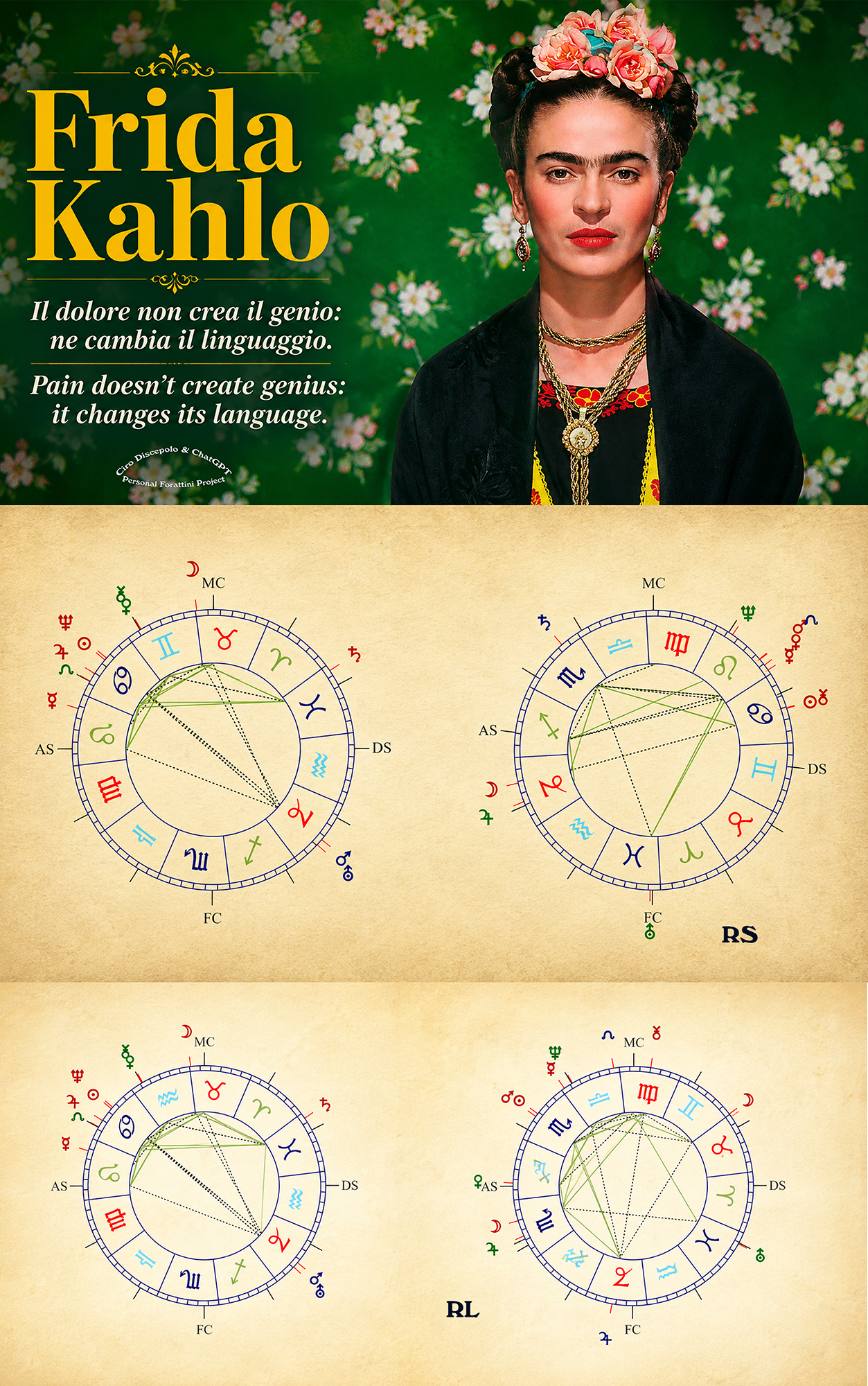
Obviously, both the Solar Return and the Lunar Return of that event were textbook (Discepolo’s).
In the Solar Return of the previous July, we observe chilling elements: four stars (Mercury, Venus, Mars, and Neptune) in the Eighth House, which is not only the house of death or mortal dangers, but also represents one of the most serious violations of the thirty-four rules dictated by the author.
Uranus on the Third House cusp (road accidents) – Fourth House (excessively long hospitalizations) and Saturn in the Eleventh House, another important indicator of mortal danger, complete the picture.
In my opinion, he was saved only thanks to the presence of Jupiter in the First House. Let’s remember that his birth data, certified with a double A directly by Lois Rodden, indicates: Coyoacán (outskirts of Mexico City), July 6, 1907, 8:30 a.m.
The Lunar Return of September 8, 1925 is, if possible, even more impressive.
We find the Sun, Mars, Mercury, and Neptune in the eleventh house, which, in this writer’s opinion, is even more mournful than the eighth.
Also note the very close Sun-Mars conjunction, the Ascendant in the Third House (car accidents), Saturn in the First House (bones, bones, bones, and more bones), and Uranus on the cusp of the Sixth House (surgeries and hospitalizations).
Perhaps, in this case too, it was the very close Venus-Ascendant conjunction that saved her life.
But at the same time, in my opinion, it aggravated a stigma already present in her natal chart: the almost perfect Venus-Pluto conjunction in the sign of Gemini.
This speaks to us of the extremely important role sex played in her life.
But it couldn’t have been the kind of sex that primarily travels on the wavelengths of a Venus in Taurus or Pisces.
No.
Here, it was mostly brain sex.
Lots of brain sex.
Amplified by the very close conjunction of Venus and Pluto, it forces us to talk about eroticism even before physical sexuality.
A very powerful eroticism.
We cannot know whether this was also a necessity imposed by her physical condition and whether it pushed her, at least in part, to favor a less or less penetrative type of sexuality.
Her love affairs were numerous.
Men and women.
Among the men, we remember, according to many sources, the Russian revolutionary Leon Trotsky and the poet André Breton.
Among the women, Tina Modotti, a communist militant and great photographer of 1920s Mexico, is mentioned; most likely, Aleksandra Kollontai (1872-1952), Soviet ambassador to Mexico between 1925 and 1926, the dancer, choreographer, and painter Rosa Rolando (1897-1962), and the Mexican singer Chavela Vargas (1919-2012) also exerted a strong fascination on Frida Kahlo.
I would like to point out to my four readers that this Christmas Sky demonstrates, once again, some fundamental paradigms of my school.
First and foremost, the angular aspects with zero or near-zero orbits.
As you’ll find written in almost all my books, and repeated ad nauseam, pay close attention—maximum attention—to all angular aspects with very close orbits.
In this chart, we find three that, in my opinion, explain ninety percent of the entire picture.
The first is the aforementioned erotic-sexual conjunction of Venus and Pluto in the mental sign of Gemini.
The second is the very close conjunction of the Sun and Neptune, which marked, through alcohol, opiates, pharmaceuticals, and various drugs (including a lot of morphine), the entire life of this extraordinary and exceptionally talented painter.
Last, but certainly not least, we find the close, very close, Mars-Uranus conjunction in the Fifth House, which brings us back to another fundamental paradigm of my school: the libido, where everything begins.
That conjunction occupied the Fifth House: the House of love, sex, but also of artistic expression in the broadest sense.
It’s no coincidence that many great authors and film directors present a similar configuration.
Frida Kahlo’s creativity was volcanic, precisely as demonstrated by the symbolic power of the Mars-Uranus conjunction.
The fact that it was in the sign of Capricorn, besides telling us about the mutilations and indescribable wounds her body endured throughout her life—especially to her bones—also tells us that it was precisely from that extraordinary, typically Capricornian, ambitious drive that Frida drew the most powerful impetus for her art.
It was a true creative alchemy, more pyrotechnic than fiery.
A marvelous film that recounts her life and that caliente Mexico, in every sense, that each of us loves to dream of, despite knowing how terrible, even today, many of the realities that pass through it are.
In the film Frida (2002), based on Hayden Herrera’s biography and directed by Julie Taymor, a splendid Salma Hayek brings us closer than anyone else to the small-but-great universe that was Frida Kahlo.
You can find much more information about her life in the film itself and in the numerous biographies dedicated to her.
Here, I did not intend to write a complete astrological biography of her life.
My goal was different.
I wanted to focus on some essential points of her birth chart, which, in my opinion, explain much of this woman’s extraordinary artistic and human personality.
A woman who managed to transform almost unimaginable physical pain into a universal language.
I close by recalling that Frida Kahlo died at the age of forty-seven, just one week after her birthday.
And this detail, for those familiar with my studies on Solar Returns and the so-called Twenty-Day Law, is certainly worth noting.
Ciro Discepolo
Milan, July 4, 2026Fine modulo
Good morning Ciro,
I am currently reading your “I fondamenti dell’astrologia medica”, and I noticed that in some of the several graph that you propose as examples you show the Quincunx aspect (e.g. quincunx between Neptune and Mars, in the natal chart of Marylin Monroe). But in other works (“L’interpretazione del tema natale”, if I am not wrong), you say that you didn’t find the Quincunx as an aspect worth to be taken into consideration.
So, if I didn’t misunderstand something, I would like to know to what extent that aspect has relevance for your school.
Thank you Master,
Antonio
Buongiorno, Antonio.
I can suddenly confirm that this aspect is not part of what I hold in consideration and, we can say, there is no more fatto part of this story. In this book, it is often written in graphics: if I indicate the chapter and the page in which the graphic question is concerned, we will cover the structure of the structure.
Good Morning Master,
in your books and writings (the ones I’ve read so far), you speak about the exorcism of the non-harmonic aspect of the “fearsome planets”(Mars, Saturn, Uranus, etc) to all the others. How can someone exorcise a non-harmonic aspect between two “good” planets? For instance, how can someone exorcise a natal Moon-Venus square?
Thank you!
Antonio
Good morning, Antonio.
I remind you that we have an unfinished answer because you asked me about a chart of Marilyn Monroe in which I drew a quinquonce, an aspect I don’t use. I asked you which page in the book this chart is located, and you didn’t answer.
Please complete your question whenever you like.
Now, moving on to the topic you raised this morning, I remind you that, in my opinion, the books I’ve published shouldn’t be read as if they were sealed, waterproof cards with no communication between them.
All my books attempt to express the fundamental concepts of my school in different ways.
In the specific case you’re referring to, I’ll suggest a path you could follow.
On page 66 of my fourth Italian edition (but the book is also available in English) of “Transits and Solar Returns,” the meaning of the Moon in disharmonious angular aspect to the Sun is explained.
The first few lines are devoted to a general description of this transit. Then the Reader will ask: “So, what do I do?” and, in the following lines, you will find practical advice, which in this case is:
During this type of planetary transit, we would do well to avoid any opportunity
for conflict by staying alone or getting some exercise outdoors. Our
bad mood, in fact, can be perceived from a distance and puts others in a bad mood
around us. This transit can even cause us
to experience hours of genuine unpopularity, or we might see it materialize through a real act of hostility on the part
of a boss, a superior at work, or a senior colleague. It is also
possible to receive a serious reprimand from our father, brother, or
husband. In short, this transit is not a terrible one, but
even in its brief duration, it establishes a terrible relationship between us
and our entire environment. This justifies, on our part, a countdown
to determine when it will end. It’s only a few hours,
but it’s particularly annoying. It’s absolutely not the right time,
as you can understand, to ask for a raise or career advancement.
Good Morning Master,
although my English is pretty good, sometimes I miss something, and in this case I didn’t get to reply to you. The page of the book “I fondamenti dell’astrologia medica” regarding the Quincunx, is page 146, example 33.
Regarding the second question, thank you for the explanation (by the way I have the book “Transits and Solar Returns”, 3rd edition) but I asked you about a square aspect between Moon and Venus, not Moon and Sun. And, more importantly, I meant the exorcism of the aspect regarding Moon-Venus in a natal birth chart, that should last all life long, without reference to transits. This is an aspect that I have in my natal chart and that I would like to work on.
Antonio, regarding Marilyn Monroe, that graph, created with an old software of mine, contained a bug and highlighted this aspect. To be more precise, it wasn’t even a bug, but rather the fact that the graphs produced by that software were also marketed to colleagues who used and continue to use this aspect.
Then, since MyAstral was born, the rules I passed on to the programmers have been stricter, and I no longer allow the quinquonce to be drawn. You can see proof of this in this YouTube video of mine from about a year ago: https://www.youtube.com/watch?v=1AUtBrVJ76c&t=15s
It specifically concerns the explanation of Marilyn Monroe’s sky and shows a large and beautiful (in my opinion) natal sky of the actress where you will no longer find this angle drawn.
Then you write to me:
Regarding the second question, thank you for the explanation (by the way I have the book “Transits and Solar Returns”, 3rd edition) but I asked you about a square aspect between Moon and Venus, not Moon and Sun.
No problem: a few pages later, on page 71, and not on page 66, you will also find this explanation.
Thank you Master,
just a small note regarding the second question.
Since we are dealing with aspects in a natal chart and not with transit, every aspect can be read from two point of views.
In this case (and in general for every aspect between two planets in natal chart) the aspect can be view as Moon square Venus and also as Venus square Moon. So I have to exorcise them in both ways (although such ways are similar to each other)?
Yes, my advice is to do that.
Dear Mr. Discepolo,
Over a year ago, I launched an online business specializing in the trading of collectible items. Specifically, my VAT number was registered on April 30ᵗʰ, 2025, and I have since been operating continuously, experiencing the usual highs and lows of entrepreneurship.
For context, I was born in Milan on August 16ᵗʰ, 1992, at 9:39 PM (as stated on my birth certificate). My upcoming Solar Return will occur on August 17ᵗʰ, 2026, at 02:47 AM while I am in Gandia (Valencia, Spain).
In analyzing this chart, I noticed a strong emphasis on the 5ᵗʰ House (creativity, personal projects) paired with a significant activation of the 10ᵗʰ House (career, public life). This combination suggests a potential transition where a personal passion or individual project evolves into a broader professional endeavor, encouraging me to take a major step forward.
Furthermore, based on your book 𝘌𝘭𝘦𝘤𝘵𝘪𝘷𝘦 𝘈𝘴𝘵𝘳𝘰𝘭𝘰𝘨𝘺 (Ricerca ’90 Publisher, 2012), I learned that it is possible to “re-baptize” an existing business under favorable astrological skies. Since I originally started my business without considering planetary alignments, I would like to elect a new moment to re-dedicate it.
I have identified August 17ᵗʰ, 2026, at 1:25 PM (Gandia, Spain) as a target moment. At this time, the new Solar Return will already be active, and Mercury (commerce) will be conjunct Jupiter (great fortune) positioned in the Gauquelin zone of the Midheaven (success).
Regarding this setup, I have two questions:
1) What is your assessment of this specific Event Chart?
2) What concrete action should I take at that exact date and time to effectively “re-baptize” the business? Please note that this is an online business operated through a third-party marketplace rather than a personal website.
Thank you in advance for your time and guidance.
Best regards
Good morning, Paolone.
I remind you that in this space we can only discuss one topic at a time, not a significant portion of a person’s life with multiple questions about them.
However, underlying all of this, I believe there’s a fundamental error or typo that prevents me from supporting you in this endeavor, which seems rather suicidal to me: you (or someone on your behalf) have planned an Aimed Solar Return where, to place Jupiter in the second house and Venus in the fifth, you would like—above all—to place Uranus in the twelfth House and Mars in the first.
Here, we only deal with Active Astrology and, above all, Astrology for the good of people, not for their harm, and therefore I really can’t help you.
Dear Dr. Discepolo,
I hope you are well.
I have found three possible destinations for my Lunar Return of 3 August and I would be very grateful for your opinion on which one you consider the best, or if there is a better option that I missed.
The options are:
* Saint-Denis, Réunion
* Karachi, Pakistan
* Nuuk, Greenland
My birth details are:
11 May 1980
13:31
Livorno, Italy
Thank you very much for your time and guidance,
Best regards,
Valentina
Good morning, Valentina.
I think I would choose Narssarssuaq, Greenland (Denmark) rather than Nuuk, because I wouldn’t want to place both Neptune and Saturn in the 7th House if I could split them between the 6th and 7th, leaving Neptune—which is far less dangerous—in the 6th House.
Furthermore, doing so would place Mars and Uranus in the 9th House, for reasons everyone is familiar with.
However, there is still the issue of Venus in the 12th House to resolve: as you know, I would only accept that under certain conditions. In my case, the primary condition would be the protection of my wife—specifically, Daniela having a favorable active ASR and a favorable active ALR.
As for the ASRs and ALRs I cannot control, I would simply have to let it go—at least regarding this specific point.
Dear Dr Discepolo,
thank you for your reply.
I wish you a wonderful birthday and all the very best for the year ahead.
Safe travels,
Kind Regards,
Valentina
Good afternoon,
my partner is psychologically “torturing” me because he wants me to travel for my birthday next year.I was born in Catania on May 7th, 1987, at 04:23 in the morning.I have a daughter who is almost one year old, and I work as an employee for a multinational corporation.He has tried to find some solutions (Dubai, Muscat, but he says that I probably can’t afford the ascendant in the tenth house!), but he told me he is not convinced, and so I am here to ask for your concrete help.
Thank you in advance, Dr. Discepolo.
Good morning, Chiara A. Regarding the “Ascendant in the 10th House” rule, given the work you do, there are no issues. However, I find the Aimed Solar Return (ASR) for Dubai—or the surrounding area—rather unfavorable, and I am not sure where its influence would actually manifest. There is certainly an indication of a major financial outflow, undoubtedly due to the Venus-Saturn conjunction in the 4th House (real estate transactions). In this case, though, shift your location slightly so that Pluto falls well within the 2nd House.
All the best.
Thank you from the bottom of my heart for your quick response.
At this point, since this is my first aimed solar return, I kindly ask if you could please help me find the best location (which I completely understand might not be around the United Arab Emirates) for my upcoming 2027 birthday.
Thank you again, Prof. Discepolo
I was born in Catania on May 7th, 1987, at 04:23 in the morning
Chiara A., if there’s no reason to fear health problems, I would choose to place Jupiter at zero degrees from the Midheaven here: INVERNESS/DALCROSS, NORTH WEST SCOTLAND (UNITED KINGDOM)
Best wishes.
Dear Ciro, thank you so much for the publishing work you do.
May I ask you something for my mum, please?
She was born in Rio Saliceto on 22 Jan 1957 at 10:00 am. As you may see, her 2027 SR around her birth town doesn’t look good at all.
Unfortunately, due to medical concerns and physical limitations, she may not be able to take a long trip. I offered to accompany her to Muscat, but she doesn’t feel safe taking such a long overseas journey.
I looked at Lecce, where she wouldn’t be afraid to travel, using the Frecciarossa. Is Lecce slightly better than her birth town?
Are there any other locations in Italy – or close to Italy – that would be better?
Also, could you please indicate which of your books explains well how to exorcise the symbols (Italian editions)?
Thank you so much!
Gladstone
Gladstone, are you asking me if you can accompany your mother to Lecce and leave Mars in her sixth House? It’s a joke, right?
To begin reading my books that explore the topic of exorcising symbols in depth, I recommend starting with my “Astrologia Attiva,” published by Edizioni Mediterranee.
Dear Ciro, she won’t be coming with me to Muscat, so I just feel helpless … MyAstral did not show me any closer locations.
Wouldn’t there be any “compromise” locations which are close enough so that I could hope she accepts to go there with me?
Thank you for the “Astrologia Attiva” book suggestion.
Dear Gladstone,
I’ll answer you like the character in the movie “The Fugitive” who, to a similar question, replies, “I don’t plead guilty.” (Io non patteggio!).
Hello Ciro, I hope your ASR went smoothly, I’ve just got back from mine in Clifden. This year, for the first time, I haven’t followed your suggestion, Ufa Russia, for two reasons; first I can’t afford Saturn in II and second I have no intention whatsoever to get involved with the purchase of a new real estate. In fact, if anything, I would love to do exactly the opposite and sell a property I’ve inherited.
I really hope to make the most from Venus at MC and limit any damage from an insidious VII house!!
Best,
Andrea C born in Piacenza on 17/7/71 at 10.50am
Well, Andrea C., as they say in my area: “Best wishes and happy birthday!” (“Auguri e figli maschi!”).
Dear Ciro
I have a question on how to interpret a stellium in the 5th house in a RSM. My current rsm has a stellium in 5 th house with Sun, venus, mercurius ( cuspis also in 4) and mars.
My datas are 17.12.64 at 16.42 in Rimini. My solar return was in Stolby some km above Yakutsk Russia.
I am half a way through my year and I have of course seen already the effects of the stellium. At the beginning , the first two months I received some information on my ex that determined me not to accept his request to be back togheter and I decided to leave him for good. Than i started another relationship with a different man , you ger than me, but we have up and downs. My questions for you are many: 1 can I get love stability in a year where there is mars in my 5th house? How can I help stability in my love life not withstanding mars? Shall I try to put always good planet in 5th or 7th house of my lunar returns? Where shall I go for my lunar return on august? I checked Maldives or Myanmar. What do you suggest? I am reasoning right?
Dear Vipsania,
A good rule of thumb for managing the ongoing Aimed Solar Return is: “Never tilt at windmills,” which, in its Chinese translation, roughly translates to: “Better to go down the river than to try to go upstream.”
I’m sure that if Zeus had interviewed you on the eve of this ASR, warning you of “trick” like the ones you described, you would have replied: “Who cares… I’m fine with that.”
Then, as always happens, once you experience the ASR from the inside, your perspective changes and you’ll want to patch things up. I strongly advise against it and suggest you go with the flow, which won’t be as bad as it seems to you right now.
Subsequently, all things considered, considering what I’ve been trying to explain for years about the possibility of implementing ALRs of the 2.0 type throughout the year, you can even implement the August one, if you really like it (with some risk).
Best wishes.
Dear Dr. Discepolo,
I hope you had a safe trip back.
It may be logistically impossible for me to reach Narsarsuaq, Greenland for my August 3, 2026 ALR. If that ends up being the case, instead of remaining in Stockholm, Sweden would you consider St. John’s, Newfoundland and Labrador, Canada or Nuuk, Greenland, to be an acceptable compromise for a Lunar Return?
My birth details are: 11 May 1980 at 13:31 in Livorno, Italy
Thank you very much for your time and guidance.
Kind regards,
Valentina
Dear Valentina,
yes, in a pejorative sense (i.e., by placing the entire bad stellium in the seventh House), you can.
Dear Dr. Discepolo,
Apologies for sending two messages on the same topic, relating to my August 3, 2026 ALR. I have now realized I should have included specific questions for clarity, hence this follow-up.
When it comes to St. John’s, Newfoundland and Labrador, Canada, my concern is the Sun on the cusp of the 11th house when there is already a Mars/Uranus placement in the 9th house and a Saturn/Moon/Neptune placement in the 7th house, which, together with Jupiter on the Descendant of my ASR, might trigger a lawsuit or a similar issue. Would you agree, or am I off the mark?
Nuuk, Greenland, was originally discarded because, unlike Narsarsuaq, it does not split Neptune away from the 7th-house stellium. Yet, compared to St. John’s, the Sun is placed in the 10th rather than the 11th house.
When having to compromise if Narsarsuaq cannot be reached, are either destinations acceptable for an ALR compared to remaining in Stockholm, Sweden?
My birth details are: 11 May 1980 at 13:31 in Livorno, Italy.
Thank you very much for your time and guidance.
Kind regards,
Valentina
Dear Valentina,
no, that’s not right. I can recommend a good ALR, but then, if you can’t go there, you’ll have to choose an alternative that I wouldn’t choose.
thanks Master. All clear!
Master Ciro
I’ve check my Solar Revolution for this year for Rimini I don’t like too much saturn in the sixt house.
What do think about Paris?
I quit already my marriage and I don’t want and have babies and I would like to change the haouse where I live now. I’m born 24th July 1973 at 5,25pm in Rimini
Good morning, Samantha.
If your goal is simply to remove Saturn from the sixth House and Mars from the eighth, then the eastern suburbs of Paris might be fine, just enough to keep Venus from falling on the twelfth cusp.
Good morning Master Ciro, many thanks for your help and so quickly reply. Do you see something else to skip? Saturn and Mars were the only black holes I’ve seen. Do you agree?
🙏
There are always “holes,” but aside from the three I mentioned, I’d say we’re doing pretty well.
🙏
I would like to ask you if I should focus on teaching hospitalized youth, given my 12th house stellium. I currently teach in standard schools. In my birth chart, I have the Sun conjunct the Moon on the Ascendant in Pisces, an Aquarius stellium with Venus, Saturn, and Mars conjunct in the 12th house, Mercury in the 1st house in Aries, Jupiter in Virgo in the 7th house, and Uranus conjunct Neptune in Capricorn in the 11th house. Thank you
Yes, S., with these positions, I recommend a solution like this.
Good Morning dear Master,
I am currently reading the book “Lettura critica del tema natale”, and I see that you give a lot of importance to conjunction aspects that are very strict.
I my natal chart I have plenty of strict squares (Sun-Uranus, Sun-Mars, Venus-Moon), but also strict harmonic aspects (Sun-Moon, Venus-Mars, Venus-Uranus). In the book you speak a lot about strict conjunctions (that I have too, regarding Moon-Saturn), but how to deal with strict aspects beyond conjunction?
Thank you,
Antonio
The principle is the same, and in books from many years ago, I write not only about conjunctions, but also about squares, semisquares, sesquiquadrates, oppositions, trines, and very close sextiles.
They always require great attention because they will play a very important role in the subject’s life.
P.S.
In case it’s needed,
6 October 1992, 9:03 AM
Lanciano (Ch)
dear Master how are you? I have to calculate the solar return of a very good friend. She is born in Dubasari Moldovia on 24th August 1985 at 1 pm.
Last year she went to Cook Islands in order to have a good year for love. Correctly you said that we should check better her birth timing and still we are. The year was good until a couple of weeks ago when she had a row with her boyfriend for the usual argument: the boyfriend is married and although they are always together he does not leave the wife and create a family with her. This is her biggest desire: an happy lovelife. Her solar return will end in few weeks and the current situation is that they split and she firmly said that until and unless the situation is cleared she will not go back to him. We all know (thanks to you) that during the 20 days before the birthdays anything can happen, but nonetheless I am trying to calculate her best return focusing on love. To this end I found Rurutu (Polinesia) or Artic Village Alaska (USA). Which one would you suggest for her?
thanks for your precious help.
Dear Vipsania,
Since your friend’s birth time is far from certain, I believe such challenging ASRs are risky, and I would proceed with 13 very short ALRs, but placing Mars a few degrees from the cusps, assuming a birth both earlier and later than the time you’re considering. Even though it will be a tough and difficult year, your friend will be able to gain very useful information about her own birth time.
Thanks master! I have a general question. Whilst calculating solars and lunars for august I notice that often it is possible to place excellent planets in 5 and 7 house only by paying the price to place the ascendant between neptune in 12 and saturn in first house at about 5 grades both.
Whilst I guess this position is totally un’accettabile for a solar return, would you accept it for a lunar return? And if so what could someone expect from those two planets? Saddness and madness?
Thanks a lot for your help
Dear Vipsania, in an ALR it is possible to accept Saturn and Neptune in the first house, but it would be quite irresponsible to do so a few degrees from the Ascendant and when you are no longer twenty years old and, above all, if there are alternatives to this.
Dear Master, I study my next SR for Rimini . It is so bad. I found Gander Canada , what did u think? I live in Rimini and working in a tourism industry, divorced with a daughter of 6 years old .
Alina born in Chisinau 4/11/1985 hour 11.40 am . Thanks for your reply
Dear Alina,
I’m having a bug with my computer right now and can’t answer your question. Try asking again in a few weeks.
ok thanks . i will try next days
Hi Ciro,
I turn to write to you for my partner. For him i choose next year Akranes – Iceland. He is born on 25/01/1964 at 00:10 in Perugia. What do you think for my choose? I’m thinking is not so bad.
thank you so much for your answer.
Silvia D. This ASR is fine. If you want, try improving it slightly: since you can drive anywhere in Iceland, try moving slightly eastward to remove Saturn from the cusp and put more distance between the Ascendant and the cusp of the second House.
Best wishes.
Hi Ciro,
Thank you for your response, in that way it’s better if him goes to Hella or Hvolsvöllur. Thank you again
Silvia D., both are fine.
Good Morning Ciro,
yesterday I was reading again your “L’interpretazione del tema natale”, and in particular I stopped on the natal chart of Silvio Berlusconi. While trying to read the chart before your description, as I usually do to test my skills, I noticed that our Silvio has Jupiter in the 3rd house receiving all non-harmonic aspects. How can we read such bad Jupiter knowing that, as we know, Berlusconi was an excellent communicator, both politically and entrepreneurially? Shouldn’t a planet with bad aspects overturn the reading of its characteristics? If that Jupiter received all trigons and sextiles would have been the same?
Thank you Master,
Antonio
Absolutely not. Because I, consciously, using the principles of Active Astrology, have given up sleep in my life, and while almost all of you get excellent sleep, I’ve been reading and writing almost 20 hours a day since I was twenty.
So you’ll ask: is Mars damaged in the third House a good thing or a bad thing? It could be both. In my case, I rode the symbol in the right direction, and it was a good thing, due to the great production of writing, but it also “torn” my life apart in many other ways. For example, around the age of thirty, I realized I had to give up my car because I was speeding so much and would probably kill all my family if I continued driving.
The same goes for Silvio Berlusconi: Jupiter’s injury in third gear didn’t prevent him from successfully investing a lot of energy in communications, but he didn’t understand the exorcism of symbols, and so he also endured a merciless war by the press: before, during, and after his death.
Clear Master. At this point what I’m wondering is: how can someone exorcise Jupiter since it’s a “good” planet?
Antonio, I already answered this question a few weeks ago. I don’t remember if I answered you or another blogger, but repetita iuvant helps, and I can repeat myself.
Exorcising means, above all, “activating a symbol,” not attempting to erase it. And this means, for example, if we’ve placed Jupiter in the seventh House of Solar Return, “acting to light a fire” with one of our fellow residents, artfully, with the aim of “loading that specific area with meaning so that it won’t express itself more heavily if we stay on the balcony of our lives.”
Of course, if we don’t have a vast knowledge of the symbol and of psychoanalysis more generally, we can read many examples like the one I just described and adjust accordingly.
Where can we read many examples? We can do so, first, in my books which contain years and years of blogs where Readers asked me specific questions about their upcoming Aimed Solar Returns and Aimed Lunar Returns. There are currently 8 of these books of mine in existence, in large format, which, with an average of about 500 pages per book, means something like 4,000 pages to search through.
Thank you Master,
My doubts was just regarding planets like Jupiter or Venus, because in the books of yours that I have read you give a lot of importance to the other planets, when dealing with exorcism. So, in case of Jupiter in the seventh house, and talking about the example of the fellow residents, since we are not dealing with Mars, it could also mean that we go along with them and talk a lot in a pacific way, rather than we gather in some club?
No, Antonio, it doesn’t work that way.
One of the fundamental characteristics I’ve discovered regarding the bistable effect of Jupiter in the seventh House, for example, is that where there is peace, wars or small wars can arise.
If you don’t even know your neighbors, theoretically you’d be better off ignoring them. But the principles of exorcising symbols require us to use a different strategy.
Let’s say that as far as “wars” are concerned, everything is going well, and therefore, knowing of the bistable effect of Jupiter in the seventh, we expect something unpleasant. To avoid this, “we must offer one or more sacrifices to the gods.” However, as I’ve explained in more than one of my books, this doesn’t mean we can resolve the situation by going to the supermarket and buying a lamb and then placing it under a statue of Zeus…
No, it doesn’t work that way, and the sacrifice must be real.
So one possible strategy might be to think: “Who could I sacrifice?”
The wife? My husband? My boss at work? I’d say definitely not. However, if I deliberately argued with a condominium member who is openly rude and aggressive, couldn’t that be the right and most painless choice?
Let me give you an example. Sometimes, when it’s still cold in winter and the radiators are turned off by city regulations, we turn on the air conditioning here in the home for a few hours on “heat pump” mode. When this happens, the air conditioning unit, located on the kitchen balcony overlooking the rear of the building where my wife and I live, releases a few drops of water onto the street outside the building every few minutes, just steps from the covered part of the building.
So, when this happens, a “rather sour” condominium member starts to get agitated and make threats.
I call the plumber, who, in his wisdom independent of his profession, comments: “Yes, because you see, it’s not the water that’s bothering this lady, since she herself can’t stop the sky from raining, but it’s YOUR (the Discepolo’s) WATER that’s bothering her so much…”
Now there’s no point in me telling you how things went on this front, but the central point remains the one I’ve already mentioned: is a months-long argument with a sour fellow tenant better than a marital crisis or a crisis with the office manager?
Fortunately, the exorcization of symbols, as I understand it and as I’ve explained it in my books, isn’t prescribed by a doctor, and many can choose to go to court to separate from their wives…
Hi Ciro!
I ask you some mouth ago a place for my Solar Return. You gentifully to, propose me Fitzgerald – Wood Buffalo Alberta. I try to find something for stay for 2 or 3 day. But haven’t find. In that way I’m looking for Hay River NT . I know it’s not same like Fitzgerald. What do you think? Or are you thinking it’s better look for another place?Thank you. Silvia 09/01/1975 h: 23:36 Craiova- Romania. Thank you
Silvia, as you can see, if you move everything to Hay River, you’ll lose three significant advantages compared to the location we’d identified: the fairly close conjunction of Venus with the Ascendant, the cusp of Jupiter with the eighth house, and the separation of Saturn and Neptune between two houses.
Obviously, you can’t expect to find accommodations in these places in the dead of winter, so you’ll have to make do.
What are the possible options?
1) Search social media (e.g., Facebook) for locals to ask for hospitality.
2) Check Canadian government websites, which are very efficient in these matters and respond to emails.
3) Get there by renting a car and, possibly, sleeping in it.
Best wishes.
P.S. Have a laugh: 30 or 40 years ago, I don’t remember where I always sent people, and it was one of those very difficult-to-reach places in the Northwest Territories of Canada. A friend of mine once went there and, like everyone else, found only a Catholic nun willing to host her. That time, however, I don’t remember what happened, and the nun wanted to send her guest away. She begged her to let her stay at least until the day after, her birthday. Then the nun asked, “Discepolo sent you?”
Dear Ciro,
I would like to ask your advice on the upcoming SR of the son of a friend of mine. He needs to find a job in the industry at the end of the year, but despite holding two Master degrees (one in mechanical engineering and one in information technology / data science) and much experience in academic research, so far he didn’t manage to secure one. Besides, he would also like to engage in a new partnership, but this is secondary.
For his relocated SR I look for a place preferrably with either Sun or Jupiter on the MC, but Sun is exactly opposite Uranus, which would fall then on the IC. And Jupiter is conjunct Mars, which would then also sit in the X. house of the SR chart, Mars in the X. producing a double-edged effect.
Which option is less difficult in your experience?
The young man is born on 25. November in Frankfurt / Main at 9:49 AM (AC 24°50 Sagittarius).
I thought of a location near Belem, Brazil, with Sun on MC (nolens volens Uranus on the IC) and Jupiter at the DC for a new relationship. I seem to remember, however, you mentioned that three planets at the angles are too many. Is this correct?
In Greenland, Sun can also be positioned at the MC, but the AC SR might fall into unsuitable houses of the natal chart, or the houses get too tiny in high latitudes, so probably not a recommendable place.
Another option would be Jupiter on the MC (cum Mars in the X house) in e.g. Yakutat, Alaska or Dawson, Canada, but no planet to reinforce the partnership.
Which option would you choose? Or none of them?
I am very grateful for your suggestions and advice.
Best wishes, Anne
Dear Anne,
If you like, rewrite this post tomorrow, adding the young man’s full birth date, and I’ll try to give you some good advice.
Dear Ciro,
Sorry about my lapse with the birthdate.
The young man is born on 25. November 1992, at 9:49 AM (AC: 24°50 Sagittarius) in Frankfurt am Main / Germany.
Many thanks for your help,
Anne
Dear Anne,
I have some advice for your friend’s engineer son.
His strong point is definitely Jupiter in the ninth House, trine Saturn in the second House. I would have him immediately relocate to A Coruña, Spain, where it would be zero degrees from his Midheaven.
Then, for the next Aimed Solar Return, I would advise him to go either to Red Dog, Alaska, or to Petropavlovsk, eastern Siberia.
In the first case, we would place Jupiter exactly on the tenth/eleventh House cusp, placing Mars in the eleventh, and, furthermore, we would place Venus in the first House, which is not bad at all. I believe that work, especially if he were to seek it in A Coruña (or Seville, alternatively), would definitely come his way, for several reasons: 1) Jupiter on the tenth/eleventh House cusp; 2) the Sun in the second House (but also Uranus in the eighth); 3) Saturn and Neptune in the sixth House (the first difficulties in a new work relationship, especially one far from home). The Ascendant in the ninth and Pluto in the fourth could seal the change of domicile.
In the second case, also: 1) Venus in the second House (one of the two most powerful positions for bringing in money); 2) The Ascendant, Moon, and Uranus in the ninth House (the move abroad); 3) Saturn and Neptune in the seventh House (the initial discomfort in relationships with others).
Let’s not forget that he is born with problems with others. The zero-degree conjunction of Uranus and Neptune in the first House, at birth, is also a bit worrying: all the more reason to relocate to a place where he can enjoy a very protective umbrella like an absolutely dominant Jupiter.
Best wishes.
Dear Ciro,
many thanks for your work on this chart and your general considerations on the young man’s natal possibilities, chances as well as difficulties. I believe, this generation with a conjunction of Uranus/Neptun /(Saturn) in certain houses has to experience also collective issues like economic crises etc more than others. When he had passed his first MA, covid was raging and the work situation was also difficult as hardly any new positions were on offer, Thus, he continued studying. With his Jupiter in IX, he has a strong asset, as you point out, but somehow there is also a reluctance to change from the academic life (including consulting) into the business world. I have just learned that he is short of only three further exams to pass his third MA in mathematics. Nevertheless, he doesn’t plan to pursue an academic career and wants to work for a company.
Therefore, I believe, your idea to relocate him to his JU/MC in Spain is excellent. I don’t know if he speaks Spanish, but he seems to like the country (having been there for various relocated SRs) and he has a cousin who works as a cardiologist near Madrid. Would you suggest he stays in Spain for an extended period of time and seeks work there, or only for a shorter period until he has secured a new job in any country? Maybe, for language reasons, certain places in Ireland with JU/MC (e.g. Limerick) could also be option?
Thanks also for working out the two aimed SR options. These are quite remote destinations in high latitudes — in winter probably not so easy deal with the cold climate. I hope I can convince him that extra efforts are necessary to enter successfully the next phase of his career. Despite being a triple Sagittarius, long distance travel was not much on his agenda so far.
Nevertheless, I believe, he definitely has the potential to obtain and manage a position as an engineer and data science expert, especially as he is a hard working person and cherished to solve intricate technical problems. Besides, he is good looking and well-mannered, and I really fail to understand why it is so difficult for him to reach his aims with job and partnership.
Many thanks again for the quick turnaround of this case, I keep you and the forum posted about new developments.
All the best, Anne
Dear Anne,
Your young acquaintance might settle in Spain, even if only for a short time, and then decide to return home or move elsewhere. However, in my experience, I’ve seen many people who seemingly by chance ended up living in a wonderful place for their relocation, becoming so attached to those lands that they decided never to leave.
This also happened to a nephew of mine who has been living in Spain for over two years with great happiness.
Of course, on that vertical, any other inhabited place in the world could work.
Best wishes.
P.S. I think it’s due to that unpleasant (because it’s very close) Uranus-Neptune conjunction in the first House that he’s having a hard time with the umbilical cord cutting, and Jupiter relocated to the midheaven could be the right fuel to unleash him. Last but not least, consider that at those levels of professionalism, knowledge of Spanish or Catalan isn’t necessarily required, and English can work just fine as a basic language.
Good Morning Ciro,
why the conjunction Uranus-Neptune in the first house has the effect of difficulty in umbilical cord cutting, in this case? It is due mainly for Neptune (because with Neptune in the first house we can have lack of will)?
What case are we talking about? I remind you that posts in this space cannot be considered a private chat between two people, and every time you post something, you must avoid making virtual references to any previous posts.
I was talking about the post between you and another user, just before my reply.
Sorry Master, I didn’t know I cannot make reference to previous posts.
Antonio, you can refer to previous messages, but report the text of those messages in the comment relevant to the time you are writing.
Dear Ciro,
many thanks for your further comments and help.
I can only confirm your statement, that often one gets really attached to a place one might normally not visit, but ends up by a aimed LR or SR. Myself, I visited several times towns in Andalusia for LRs I liked very much and started toying with the idea to spend extended periods in this Southern climate instead of exposing myself to the grey, wet and cold German winters.
All the best,
Anne
Dear Dr Discepolo,
I am already planning my August 30 RLM (DOB 11 May 1980, 13:31, Livorno, Italy) to avoid the logistical disruptions I encountered last month.
The options I identified are Dubai, UAE; Juneau, Alaska, USA; or Prince Rupert, Canada.
Which destination would you consider to be the best one?
Furthermore, having read your advice to another reader of the blog about her acquaintance temporarily relocating to a more suitable location to maximize his chances of finding employment, I wondered: is Stockholm, Sweden, an unsuitable place for me to be based while I continue practicing Lunar and Solar Returns in my search for employment?
Thank you,
Kind regards,
Valentina
Good morning, Valentina.
I don’t recommend the ALR in Juneau because, aside from Venus in the twelfth House, which I’d avoid for myself but which is acceptable, you’re on a knife edge because even a slight change in your birth time in the Alaskan capital would put three stars in the sixth House, and that’s absolutely to be avoided.
On the beautiful little island on the Canada-Alaska border, where I’ve been twice, it’s possible because the margins are wider.
Dubai could also be fine, if you have no objective reason to worry about that Uranus in the first House.
For the second topic, message me another day, if you like.
Dear Dr Discepolo,
Thank you for your quick response about my upcoming ALR.
I will opt for Prince Rupert, CA then.
All the best,
Valentina
Well, Valentina. But make no mistake: Prince Rupert is located in Canada, in British Columbia, right on the border between Canada and Alaska.
Good Morning Master,
regarding your following previous reply to another user:
——-
“Ciro Discepolo on August 6, 2026 at 6:20 am
Dear Anne,
Your young acquaintance might settle in Spain, even if only for a short time, and then decide to return home or move elsewhere. However, in my experience, I’ve seen many people who seemingly by chance ended up living in a wonderful place for their relocation, becoming so attached to those lands that they decided never to leave.
This also happened to a nephew of mine who has been living in Spain for over two years with great happiness.
Of course, on that vertical, any other inhabited place in the world could work.
Best wishes.
P.S. I think it’s due to that unpleasant (because it’s very close) Uranus-Neptune conjunction in the first House that he’s having a hard time with the umbilical cord cutting, and Jupiter relocated to the midheaven could be the right fuel to unleash him. Last but not least, consider that at those levels of professionalism, knowledge of Spanish or Catalan isn’t necessarily required, and English can work just fine as a basic language.”
——-
I was wandering why the conjunction Uranus-Neptune in the first house has the effect of difficulty in umbilical cord cutting, in this case? It is due mainly for Neptune (because with Neptune in the first house we can have lack of will)? Or also Uranus has its role?
Antonio, because in that case it was a very close conjunction, a fact that has extraordinary importance in my school, and, since Neptune is being influenced by a “non-light” star, the direction is that of anguish. In this case, since the subject is Moon-dominant and Mars is damaged in the sign of Cancer, we are certainly faced with a case of difficulty cutting the umbilical cord.
Dear Dr Discepolo,
I hope you are well.
I am reaching out regarding a previous query that you suggested I submit on another occasion. I hope this is a good time to ask.
Having read your advice to another reader about her acquaintance temporarily relocating to a more suitable location to maximize his chances of finding employment, I wondered whether Stockholm, Sweden, is an unsuitable place for me to be based while I continue practicing Lunar and Solar Returns in my search for employment.
I spent my latest ASR in Candelaria, Zambales, near Infanta in the Philippines.
DOB: 11 May 1980, 13:31, Livorno, Italy.
Thank you in advance for your insights.
Kind regards,
Valentina
Dear Valentina,
The fundamental laws of Astro & Geography are written in Andrea Rossetti and I in a book that is currently only available in English, but where you can find many answers.
Starting from this, you ask me if, at least for the moment, Stockholm might be a good relocation for you.
If you mean because in the Swedish capital, your natal Mars, which is very close to the Accendent, is moving away from it, then yes.
If, however, you mean what I mean, “aim,” then no. Because if we want to choose a place in the world that is very friendly to us, then we still have to look at the geographic coordinates that will put Venus and Jupiter, especially, at the four corners of the sky.
Just to give you an example, a location that could be chosen for this purpose is Kuwait City, with Venus at zero degrees from the Midheaven, or further north, on the same longitude, a place in Azerbaijan.
Dear Dr Discepolo,
Thank you for your reply regarding my suggested aimed relocation in Kuwait City, based on DOB: 11 May 1980, 13:31, Livorno, IT, and for recommending the book on Astro & Geography — I just ordered it online.
I have been living in Stockholm, SE, since December 2022 as I relocated here for a job.
Until I am able to read the book, may I ask whether there is a hierarchy between ASRs/ALRs and aimed geographical relocation?
Can Jupiter and Venus in the 6th house of my current ASR, together with regular ALRs, override the fact that I live in a location where the MC is not conjunct to a benefic planet?
Thank you again.
Kind regards,
Valentina
Yes, Valentina,
the hierarchies are always:
1) The current Aimed Solar Return is in first place
2) The current Aimed Lunar Return is in second place for each month
3) Our Natal Chart is in the background
4) Our relocation is also in the background