A new frontier for my books: Amazon audiobooks, astrology, and twenty hours of listening
In recent days, Amazon/KDP has brought several surprises my way—some of which could represent a major turning point for the future of publishing, especially for those like me who have been publishing books for many decades.
It all began with a notification regarding new opportunities offered by Kindle+ for producing audiobooks using voices generated by artificial intelligence.
I decided to give it a try immediately.
My first experiment was *Arts & Stars*, a book in English that collects various writings of mine in which astrology intersects with cinema, literature, and other cultural topics. In a very short time, Amazon produced an audio version lasting approximately five hours and forty minutes.
But the biggest surprise came the following day.
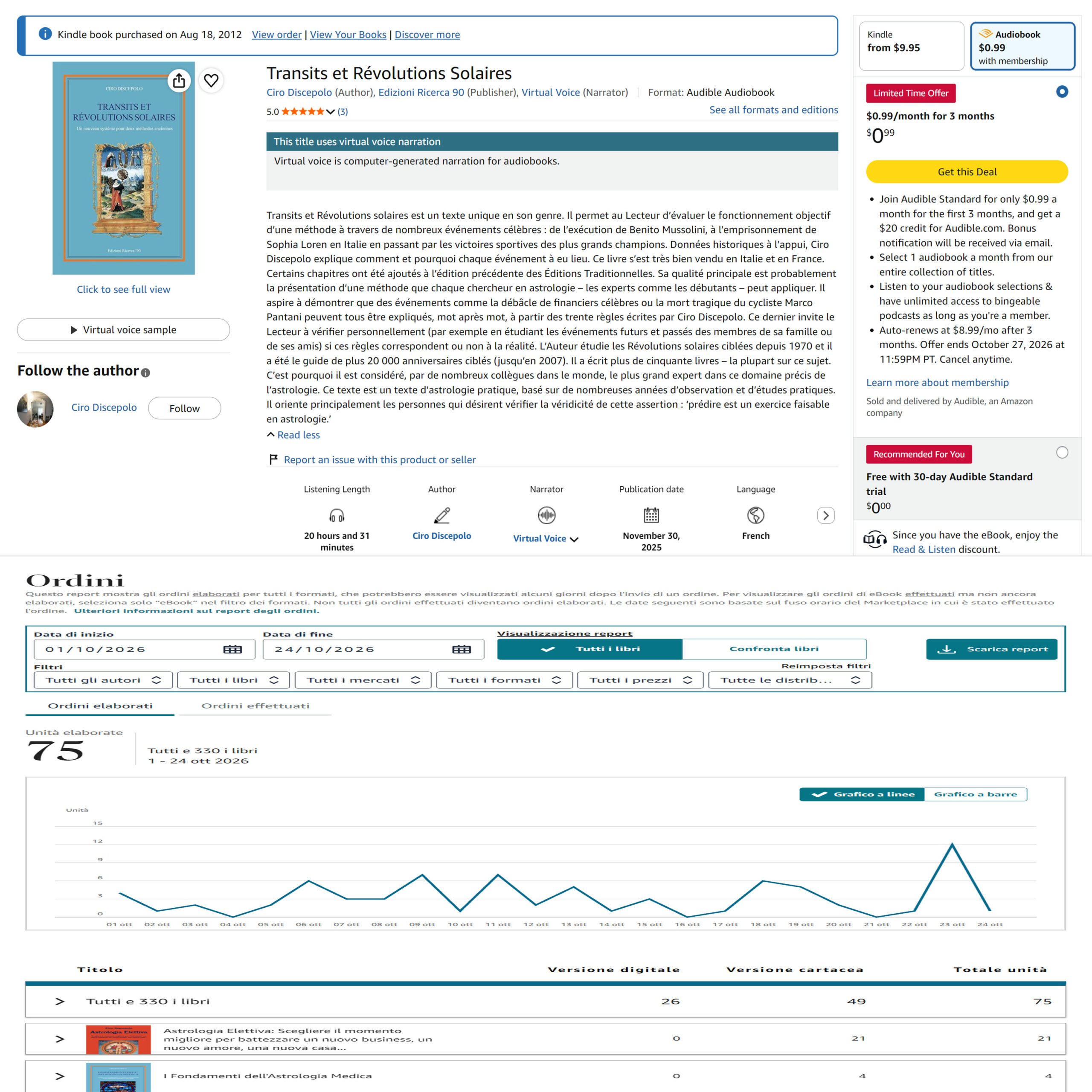
Amazon informed me that an old French edition of my book *Transiti e Rivoluzioni Solari* (Transits and Solar Returns)—published way back in 2012—was ready to be turned into an audiobook. All I had to do was log into the KDP platform, select a voice, and authorize publication.
I did so, and within a few hours, the book was available on Amazon.com.
Duration: 20 hours and 31 minutes!
What particularly intrigued me was the option—at the start of the process—to choose between different types of voices: a young woman, an older woman, a young man, or an older man. Naturally, these aren’t real, flesh-and-blood narrators, but rather synthetic voices.
I listened to a few samples from the French version—both the preface and some astrological examples—and I must say, the result strikes me as quite interesting.
But this raises a question.
What is the point of turning a practical astrology text—one containing over a hundred zodiacal charts—into an audiobook?
The first answer might be: none at all. I, however, am of a completely different opinion.
Consider an astrologer who is already well-versed in the subject and happens to be facing a long, multi-hour flight—or someone who spends a great deal of time traveling by train or car.
Why shouldn’t they be able to listen to a chapter on Solar Returns, Saturn transits, or planetary configurations, even without having the corresponding chart right in front of them?
Anyone who knows astrology understands perfectly well what it means to have Mars in the twelfth house, a Solar Return Ascendant in the tenth, or a Mars-Neptune conjunction. One can follow a technical line of reasoning through audio alone—provided, of course, that one has already studied the topic.
Naturally, I wouldn’t recommend this book to a beginner—but then again, I wouldn’t recommend the print edition to one either; it simply wasn’t written for those taking their first steps in the study of astrology.
And then there is another possibility—perhaps an even more interesting one.
Amazon has introduced features that allow users—for compatible titles—to read an eBook while listening to the narration, following both the text and the audio simultaneously.
If this feature becomes available for my books, the issue regarding the charts could largely be resolved: you listen to the explanation and, whenever necessary, view the natal chart or Solar Return on your screen.
I haven’t yet verified whether this functionality works with my French audiobook, but I intend to look into it further.
Several questions remain.
For instance, why did Amazon choose to offer a French edition that is fourteen years old, when much more recent versions exist?
And why—at least for the time being—do these audiobooks seem to be available primarily on the American market, even when the language of the narration is French? Another issue concerns my book *L’Uomo e le Stelle – Intervista all’Astrologia*—also published in English as *Man and the Stars*—which runs to over eight hundred pages and contains very few images.
It seems like an ideal candidate for an audiobook, but KDP currently deems it ineligible, apparently due to an issue with the table of contents. I have written to Amazon for clarification and am awaiting a response.
In the meantime, I am considering a possibility that, until a few days ago, I hadn’t taken seriously.
An audiobook does not necessarily have to replace a printed book. It can complement it, round it out, and offer a different way to engage with the same content.
It allows for reviewing a topic while traveling, revisiting a chapter already studied, or listening to an explanation while engaged in activities that make reading impossible.
Naturally, twenty hours of synthetic speech do not automatically equate to twenty hours of high-quality educational content. One must verify the pronunciation of names, technical terms, and astrological acronyms—and, above all, ensure that the voice does not become monotonous over an extended period of listening.
But these are issues that technology will likely become increasingly capable of addressing.
For the time being, I do not intend to indiscriminately convert all my books into audiobooks. I prefer to experiment, listen, evaluate, and gain an understanding.
After all, in over fifty-six years of astrological study, I have seen the tools used for research, calculation, writing, and publishing change many times over.
From printed ephemerides to computers, from books produced using traditional typesetting methods to eBooks, and now to translations and the synthetic voices of Artificial Intelligence.
Each time, I have asked myself the same question: can this new possibility help us work better and disseminate our knowledge more effectively?
In the case of audiobooks, I believe the answer may well be yes.
Not least because twenty hours of astrology during a long-haul flight could be far more engaging than twenty hours spent watching films one would never have chosen to watch at home…